Poultry Feed Production Line

Looking for a poultry feed production line? We deliver turnkey solutions with 1–100 t/h capacity for mash, pellets, and chick crumbles.
Poultry Feed Production
Line Overview
A poultry feed production line is a highly flexible manufacturing system. It can be custom-designed to accommodate varying production scales, specific finished-product requirements, and different investment budgets.
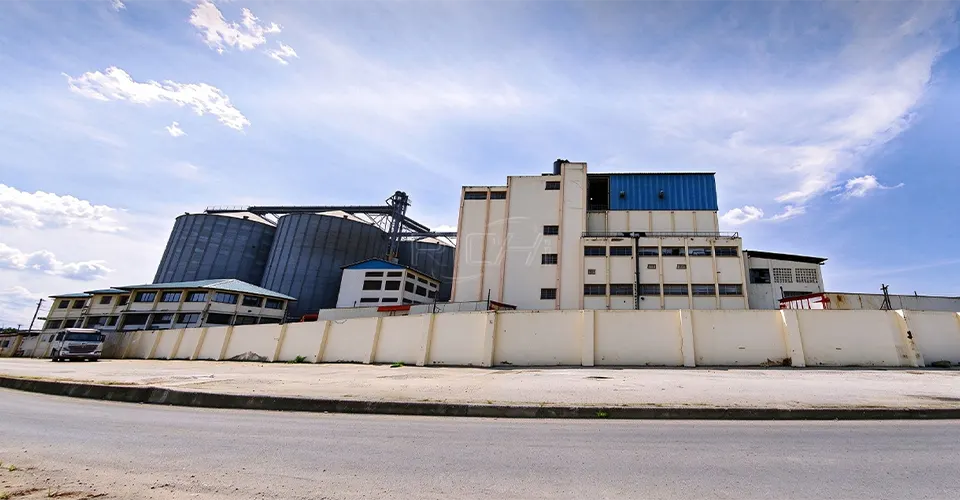

Capacity : 1~100 T/H

Price : $13,000 USD ~ $2,800,000 USD
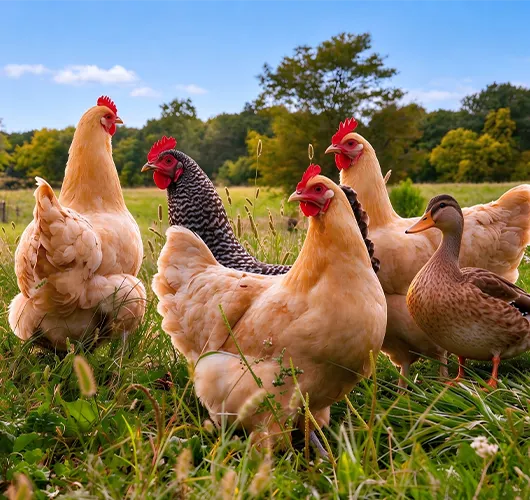
Product Type : mash feed, pellets, and crumbles for chickens, ducks, geese, pigeons, etc.
Project Videos
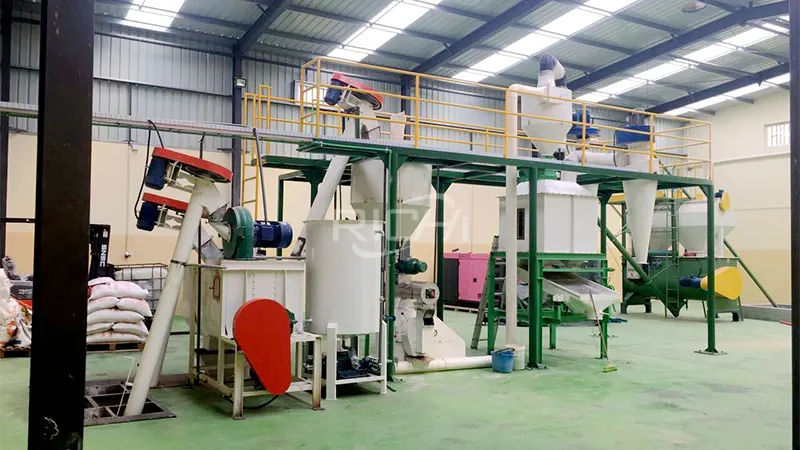
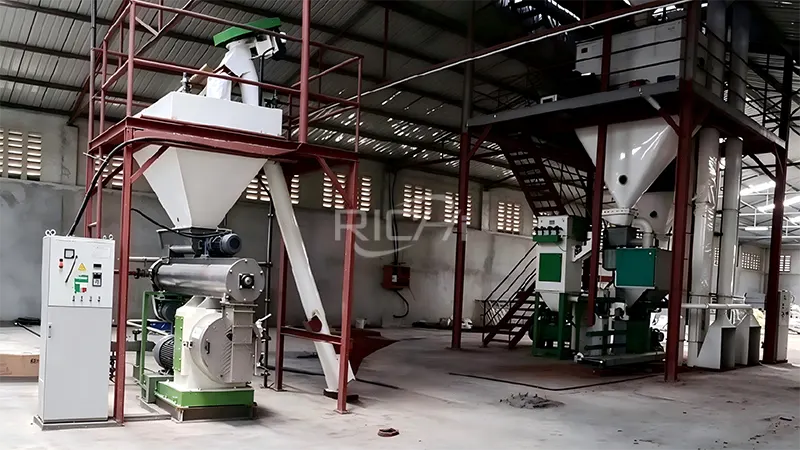
1 T/H Mash Feed + 0.8T/H Pellet Chicken Feed Line in Burundi
- Product Requirement:mash feed + pellet feed
- Equipment Configuration:hammer mill, mixing machine, liquid additon tank, small poultry feed pellet machine, pellet cooler, vibratory screening machine.

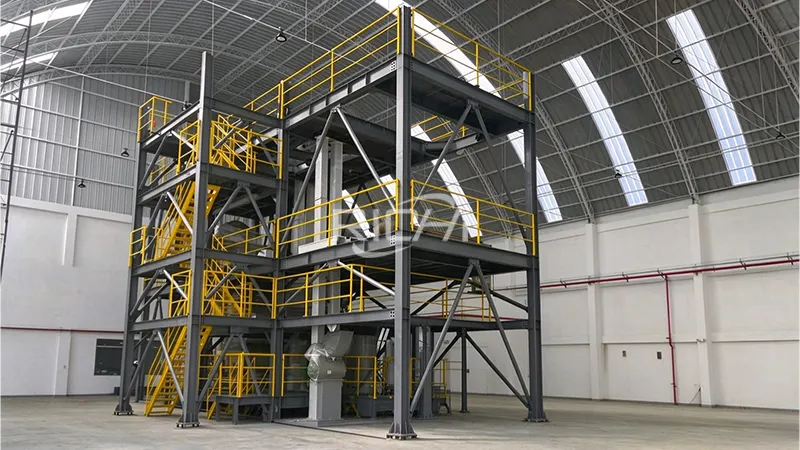
3-4 T/H Mash & Pellet Chicken Feed Line in Tanzania
- Product Requirement:mash feed + chicken feed pellets
- Equipment Configuration:hammer mill, mixing machine, liquid additon machine, pellet machine, packing machine.
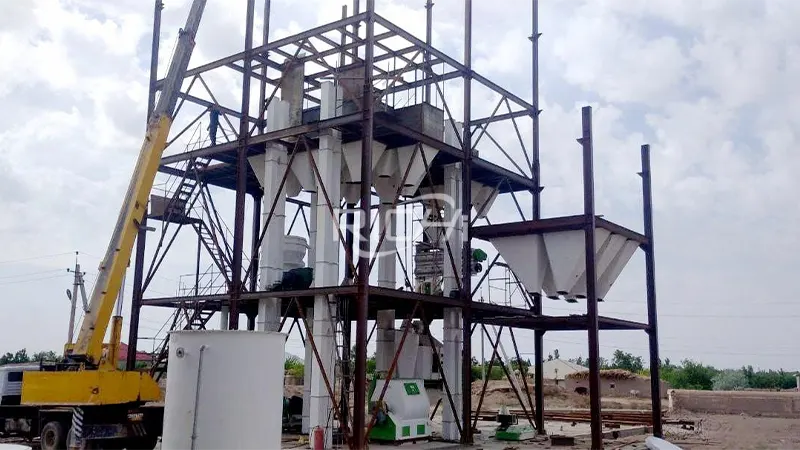
5-6 T/H Poultry Feed Production Line in Peru
- Product Requirement:mash feed, pellet feed and chick crumbles
- Equipment Configuration:PLC batching system, feed grinder, feed mixer, pellet machine, pellet cooler, pellet crumble machine, screening machine, automatic packaging machine.
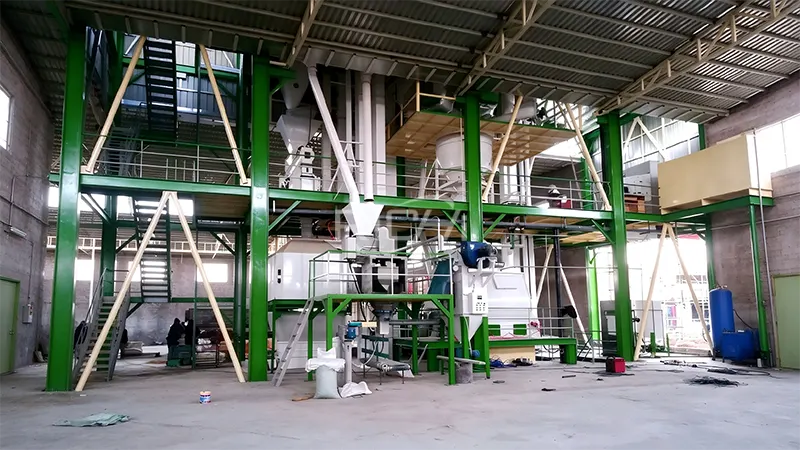
10 T/H Chicken Feed Pellet Production Line in Uzbekistan
- Product Requirement:feed pellets for chickens, ducks and geese
- Equipment Configuration:multi-bin batching system (PLC-controlled), feed hammer mill, feed mixer, pellet machine, pellet cooler, feed crumble machine, screening machine, automatic packaging machine
30 T/H Poultry Feed Line in Afghanistan
- Product Requirement:feed for chicks, broilers, and laying hens
- Equipment Configuration:multi-bin batching system (PLC-controlled), feed grinder, feed mixer, pellet machine, pellet cooler, feed crumble machine, screening machine, automatic packaging machine
Worldwide Poultry Feed Line Projects
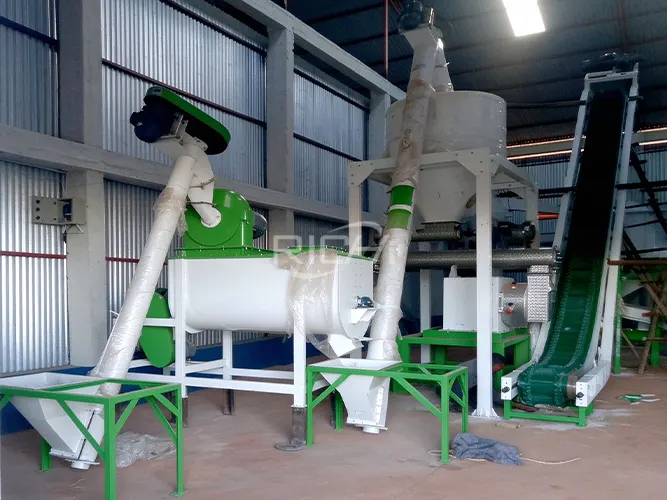
1-2 T/H Chicken Feed Processing Line in Mexico
- Product Requirement:broiler and layer feed pellets
- Equipment Configuration:feed ginder, feed mixer, chicken feed pellet machine, counterflow pellet cooler, screening machine, packing machine.
- Footprint:15 meters long, 1.5 meters wide, and 7 meters high.
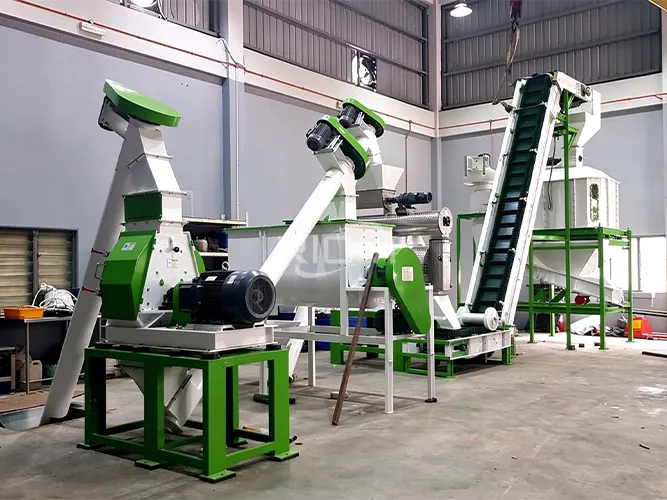
3-4 T/H Poultry Feed Processing Line in Malaysia
- Product Requirement: 2-4 mm chicken feed pellets
- Equipment Configuration:feed ginder and mixer, chicken feed pellet machine, counterflow pellet cooler, vibrate screening machine.
- Production Line Layout:L-shaped layout; requires the excavation of a raw material receiving pit.
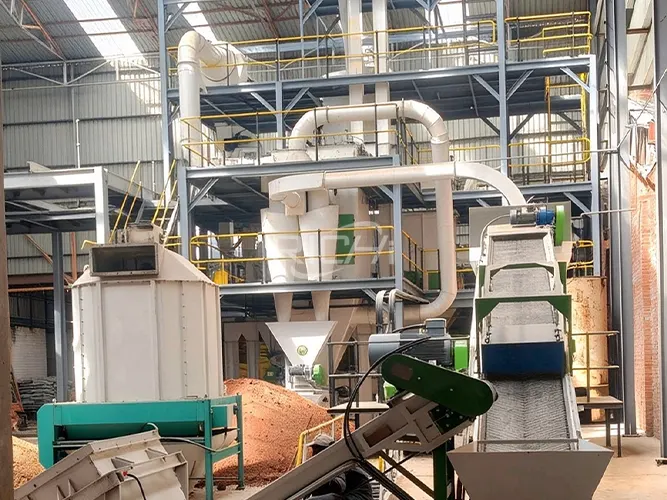
5-6 T/H Cattle & Poultry Feed Manufacturing Plant in Russia
- Product Requirement:feed pellets for cattle and chicken
- Equipment Configuration:bale breaking machine, feed ginder, feed mixer, pellet machine, pellet cooler, poultry feed crumble machine, screening machine, feed bagging machine.
- Production Line Layout:Partial steel-frame structure + U-shaped configuration
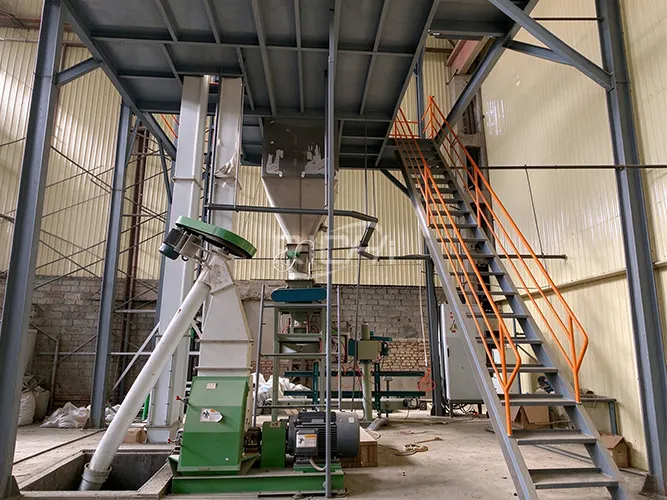
5-6 T/H Poultry Mash Feed Production Line in Kazakhstan
- Product Requirement:mash feed and premix
- Equipment Configuration:iron remover, powder pre-cleaning machine, feed hammer mill, feed mixer machine, feed bagging machine, bag sewing machine
- Production Line Layout:two-story steel-frame structure; requires excavation for a raw-material intake pit.
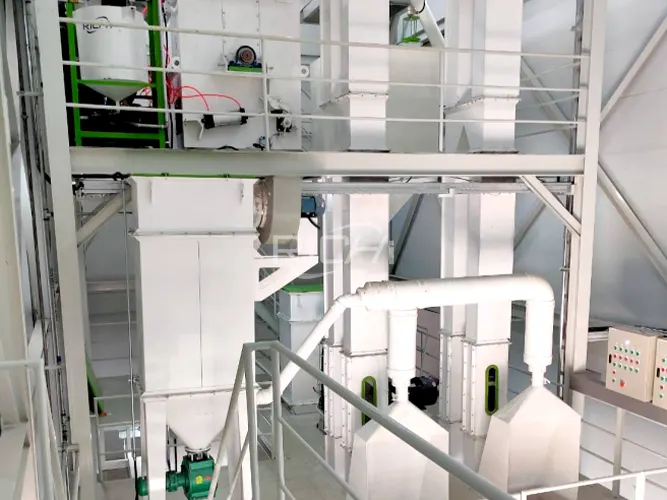
10 T/H Pig & Chicken Mash Feed Production Line in Thailand
- Product Requirement: mash feed and premix for poultry and pig.
- Equipment Configuration:two feed grinders, mixer, automatic packaging machine.
- Production Line Layout:two-story steel-frame structure
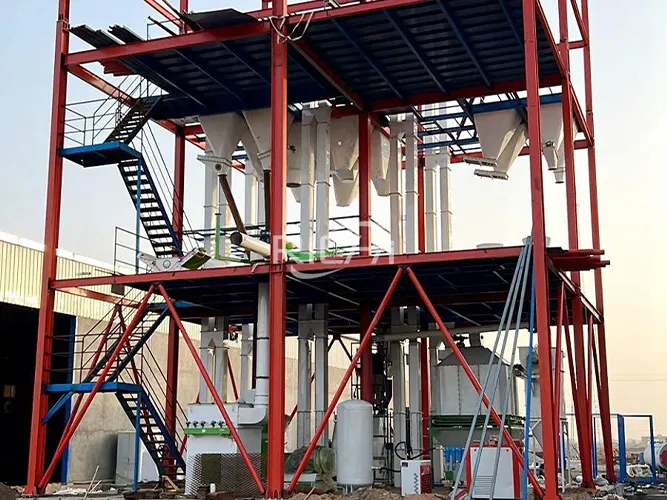
15-16 T/H Poultry Feed Processing Plant in Saudi Arabia
- Product Requirement:broiler pellet feed
- Equipment Configuration:automatic batching bins, feed grinder, feed mixer, pellet mill, cooler, pellet crumbler, screener, and automatic packaging machine.
- Footprint:11–12 m in height, 4 m in width, 5 m in length
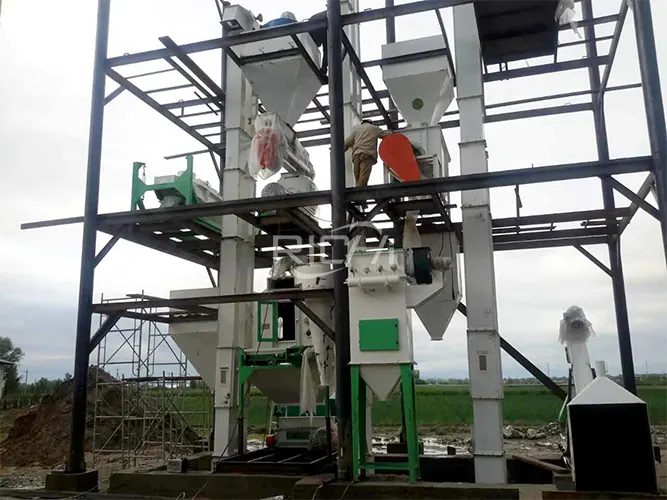
20-22 T/H Chicken Feed Manufacturing Plant in USA
- Product Requirement:2-6 mm chicken feed pellets
- Equipment Configuration:automatic batching bins, feed grinder, feed mixer, pellet mill, cooler, pellet crumbler, rotary grading screen, and automatic packaging machine.
- Footprint:15 m in height, 4 m in width, 4 m in length
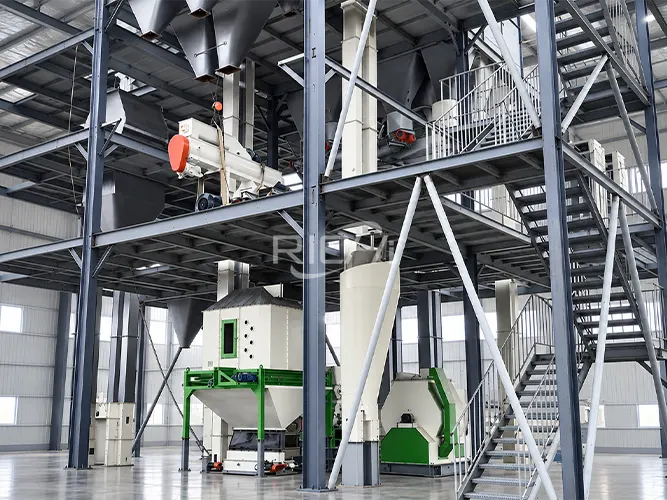
30-33 T/H Chicken Feed Production Line in Portugal
- Product Requirement: chicken feed pellets in 2-6mm diameter
- Equipment Configuration:multi-bin automatic batching system (computer-controlled), feed grinder, feed mixer, pellet mill, cooler, pellet crumbler, rotary grading screen, and automatic packaging machine.
- Footprint:15 m in height,5 m in width, 5 m in length
poultry feed production process
Poultry feed production process involves a continuous production line extending from raw material handling to finished product packaging. Small-scale poultry feed plants usually feature a more compact layout; the standard process flow includes raw material receiving and cleaning, grinding, proportioning and mixing, conditioning and pelleting, cooling, crumbling, screening, and finally, packaging and storage.
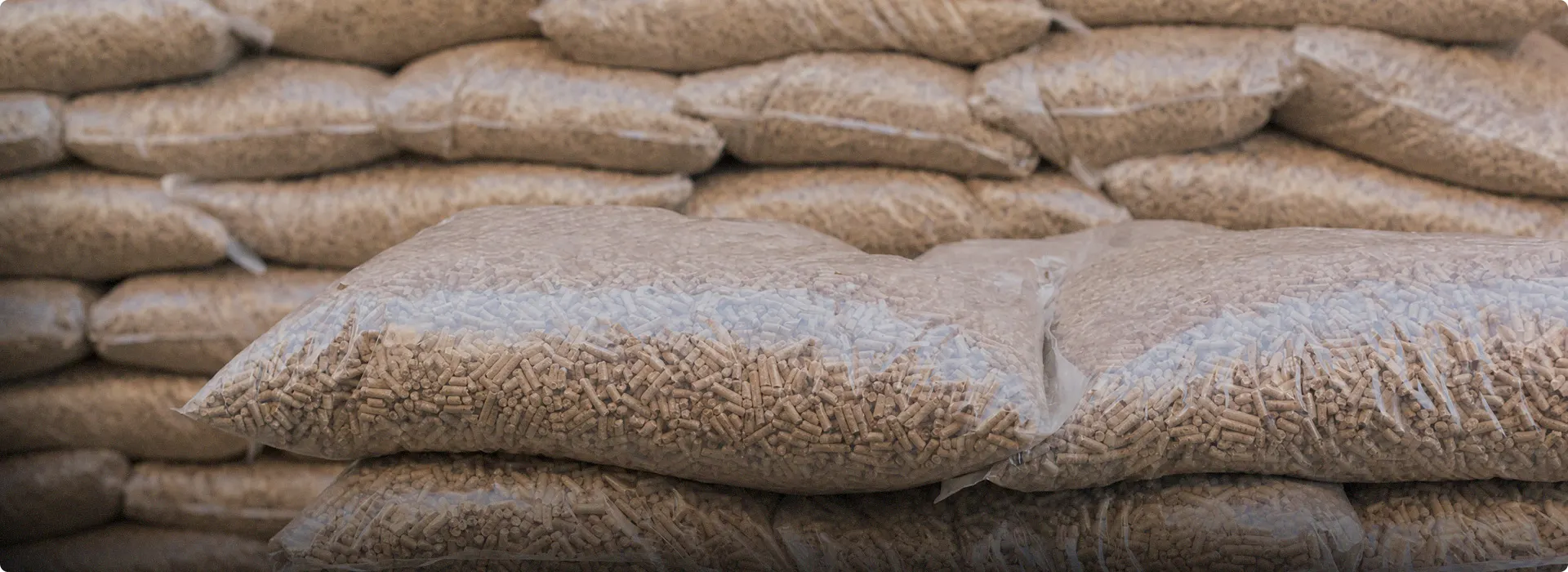
Stage 01 Pre-Cleaning
As raw materials enter the plant, they are immediately routed through pre-cleaning screens and permanent magnetic separators. This process removes contaminants like stones, rope, nails, and dust, serving the dual purpose of protecting processing equipment and guaranteeing the quality of the finished feed.
Stage 02 Grinding
Weigh the raw materials (corn, soybean meal, wheat bran, etc.) based on the formula. Then, send them into the feed hammer mill and grind them into a fine powder with a particle size of less than 5 mm.
Stage 03 Mixing
Feed them into a mixer (commonly a paddle type) for efficient mixing, ensuring uniform distribution of nutrients.
Stage 04 Pelletizing
The thoroughly mixed feed ingredients enter the pelleting stage. The material typically undergoes conditioning, a process that cooks the feed and eliminates pathogens. It then enters a poultry feed pellet mill, where it is compressed into pellets. These pellets generally range from 2 to 8 mm in diameter, with the specific size adjusted according to the different growth stages of the poultry (such as chicks, growing birds, laying hens, or broilers).
Stage 05 Cooling
Freshly produced pellets are hot and must be cooled quickly to reduce moisture content and harden the pellets, thereby preventing heating, mold growth, or clumping during storage.
Stage 06 Crumbling
If chick feed is to be produced, a crumbling process is also required. The cooled pellets are fed into a crumbler and broken down into particles with a diameter of 1–1.5 mm.
Stage 07 Screening
After cooling, the poultry feed pellets enter a grading screen to remove powder, fragments, and oversized particles. Pellets meeting specifications are transferred to the finished product silo, while the screened-out powder and substandard pellets can be returned to the pelletizing stage for reuse.
Stage 08 Packaging
The finished chicken feed pellets are quantitatively bagged, sealed, and coded by automatic or semi-automatic packaging machines before being placed into storage.
01
Pre-Cleaning
02
Grinding
03
Mixing
04
Pelletizing
05
Cooling
06
Crumbling
07
Screening
08
Packaging
1 ~ 2 T/H
3 ~ 4 T/H
5 ~ 6 T/H
10 ~12 T/H
15 ~ 16 T/H
20 ~ 22 T/H
30 ~ 33 T/H
More…
poultry feed manufacturing process flow chart
We provide multiple poultry feed manufacturing process flow charts to suit different mill types. Each design is carefully configured to match your specific needs, taking into account factors such as desired output, final product form, and available plant space.

Simple 1-2 T/H Poultry Feed Line
This solution is designed for a small-scale poultry feed mill capable of producing both mash and pellet feed. The complete line includes a batching scale, grinder, mixer, pellet mill, cooling belt, and bag-sewing machine. The equipment setup is streamlined, ensuring a low investment cost.
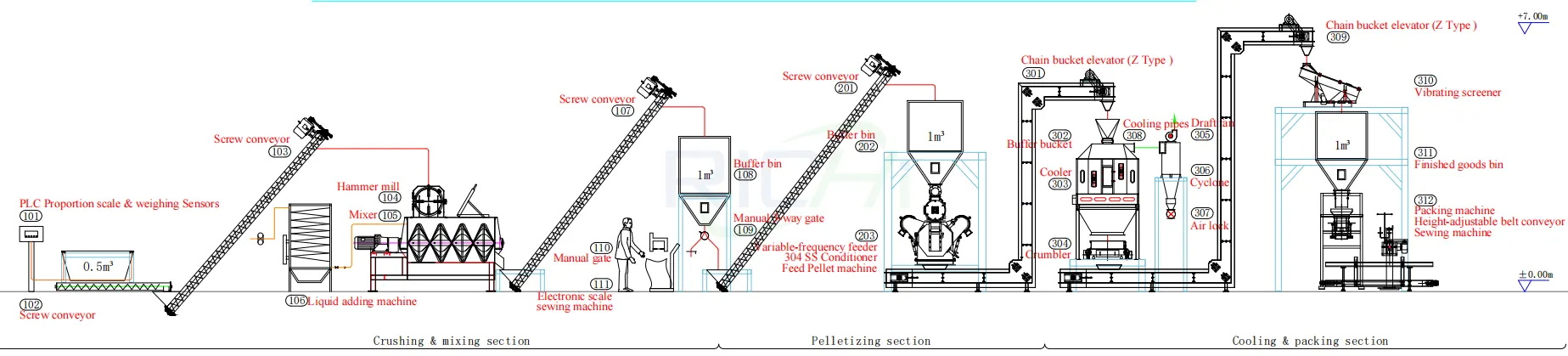
Standard Poultry Feed Processing Line
This is a standard poultry feed production line with a capacity of 1–2 tons per hour. The complete line is equipped with a batching scale, grinder, mixer, liquid addition tank, pellet mill, pellet cooler, pellet crumbler, screener, and packaging machine. This production line is capable of producing mash, pellets, and crumbles.
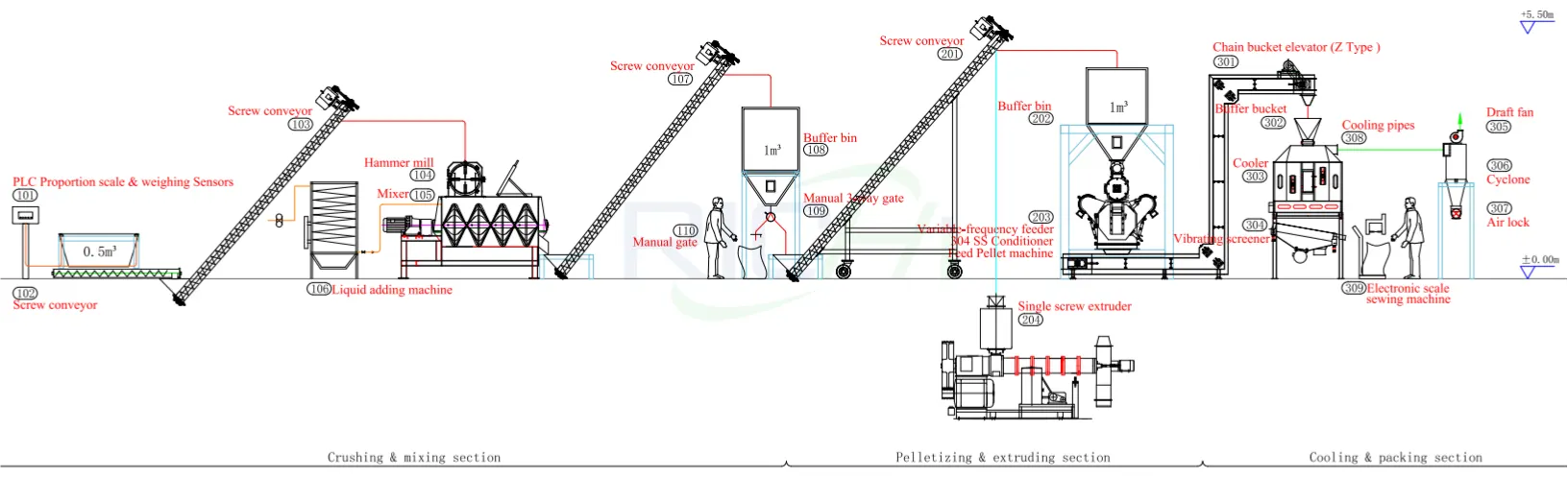
Chicken Feed + Fish Feed Production Line
This is a dual-purpose feed production line. A single-screw extruder has been added to the standard poultry feed line setup. The ground and mixed mash can be diverted via a gate valve: one stream enters the pellet mill to produce livestock and poultry feed, while the other enters the extruder to produce sinking or floating fish feed or pet food.
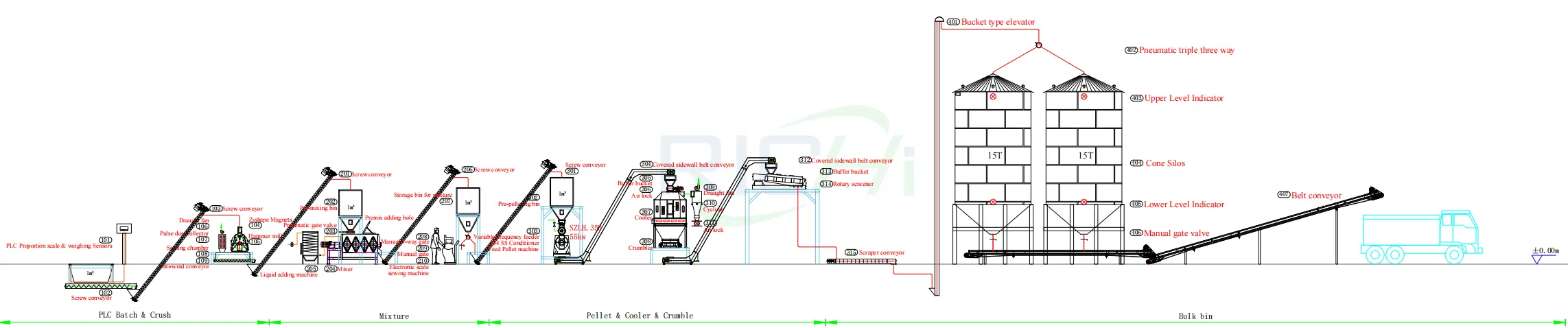
5-6 T/H Chicken Feed Line with Silos
A key design feature of this line is the inclusion of two large, independent silos for the finished product. Instead of being packaged, the finished chicken feed is stored directly in these silos. High and low-level sensors are installed at the top and bottom of each silo to monitor inventory in real time. The discharge outlet at the bottom is connected to a belt conveyor, allowing trucks to be positioned directly beneath the conveyor to receive the feed.
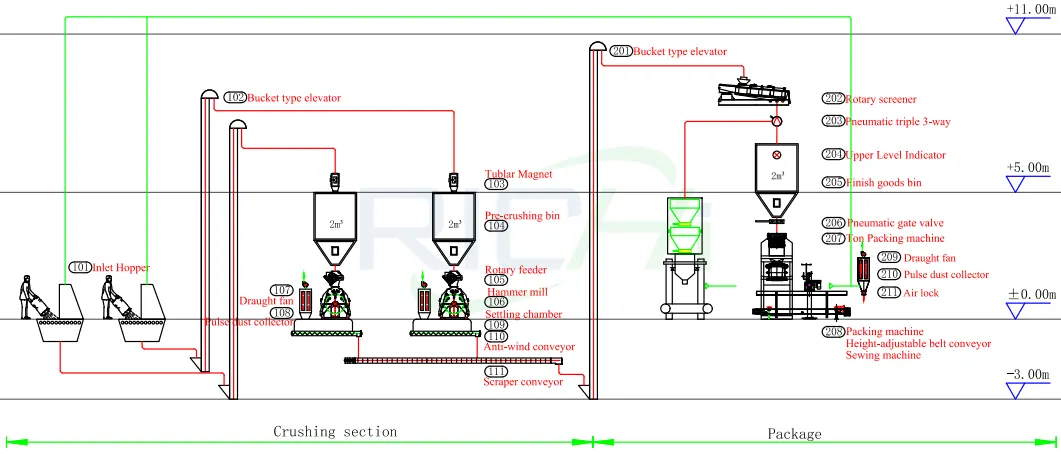
10 T/H Mash Feed Production Line
This mash feed line consists of two core modules: grinding and packaging. The grinding section utilizes a parallel dual-grinder configuration, allowing for flexible capacity adjustment. Both the grinding and packaging stages are equipped with dedicated dust-removal systems, ensuring a dust-free environment within the facility.

10 T/H Automatic Chicken Feed Pellet Production Line
The production line centers on an automated batching system. The raw material receiving area is equipped with six silos for categorized storage, each featuring high-precision load cells at its base. Through an automated control system, the facility achieves precise blending of various raw materials, thereby ensuring strict adherence to feed formulations and consistent product quality.
poultry feed Plant Price
Poultry feed plant prices are influenced by factors such as production capacity, equipment configuration, the level of automation, demand for finished products, environmental regulations, and delivery methods. There is no single price that applies to every project. To facilitate your evaluation, we have summarized typical investment ranges for different production capacities for your reference.
| Production Scale | Production Period | Installation Period | Investment Cost(USD) | Profit Period |
|---|---|---|---|---|
| 1-2 T/H | 15-20 Days | 7-15 Days | 10,000-50,000 | 1-3 Years |
| 3-4 T/H | 15-20 Days | 15-20 Days | 50,000-120,000 | |
| 5-7 T/H | 25-30 Days | 20-35 Days | 70,000-250,000 | |
| 8-10 T/H | 35-40 Days | 40-55 Days | 150,000-300,000 | |
| 12-20 T/H | 40-50 Days | 60-90 Days | 250,000-580,000 | |
| 25-40 T/H | 55-65 Days | 85-120 Days | 450,000-850,000 | |
| 50-60 T/H | 60-70 Days | 110-140 Days | 900,000-1,400,000 | |
| 60-80 T/H | 75-95 Days | 130-170 Days | 1,450,000-1,800,000 | |
| 80-100 T/H | 80-150 Days | 160- 200 Days | 2,000,000-3,000,000 |
poultry feed production machine
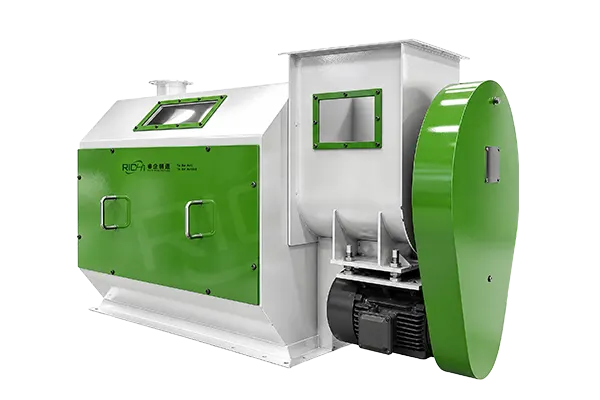
Cylindrical Cleaning Machine
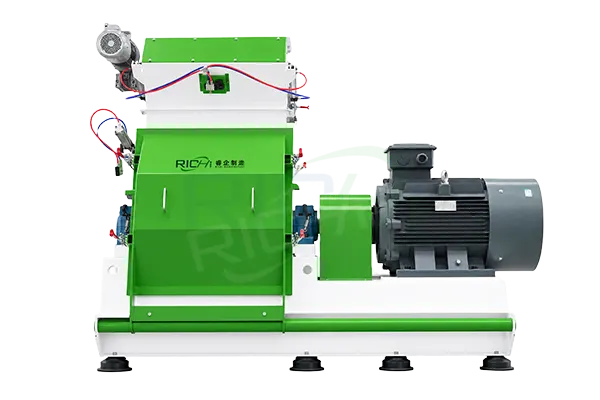
Poultry Feed Grinder Machine
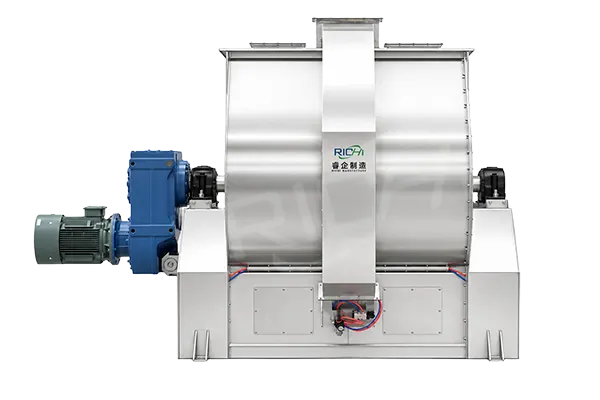
Poultry Feed Mixer Machine
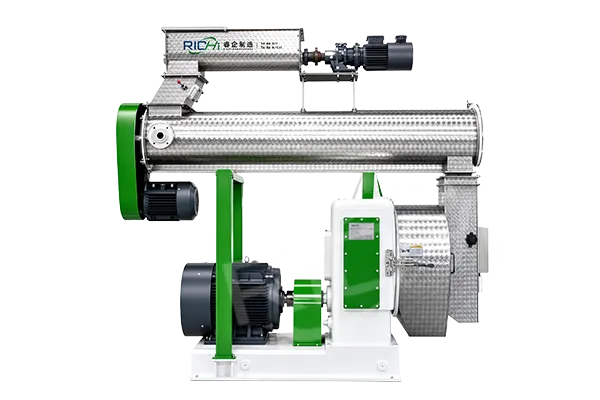
Poultry Feed Pellet Machine
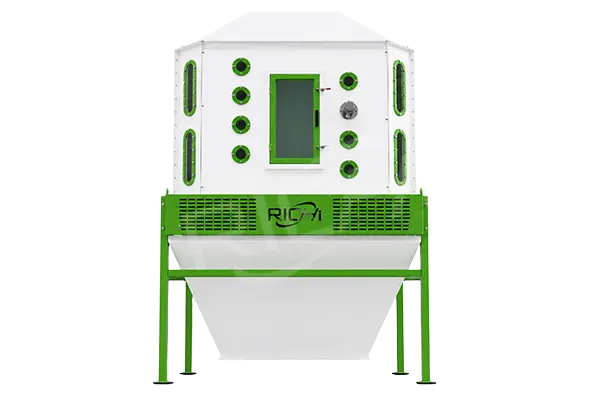
Counterflow Pellet Cooler
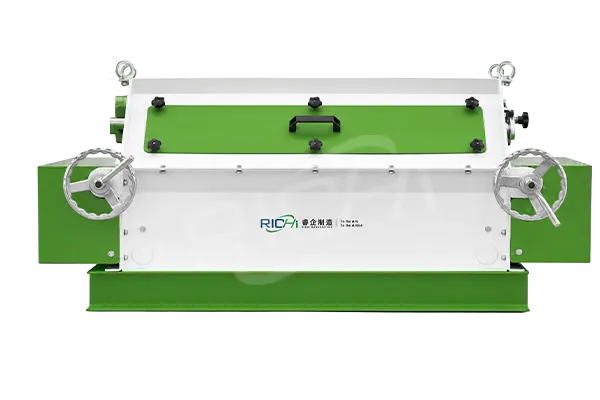
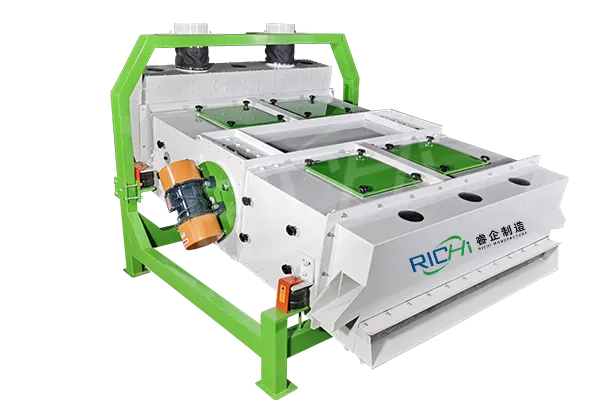
Vibrating Screening Machine
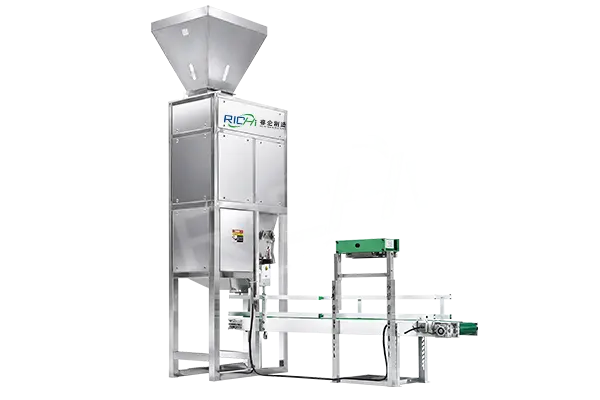
FAQ
Can your production line manufacture feed for various types of poultry—such as broilers, layers, ducks, and geese—simultaneously? Is it easy to switch between different formulations?
→
Absolutely. Switching formulations is very convenient: the PLC control system can store multiple recipes. When changing poultry species or growth stages, you simply select the appropriate recipe via the central control system, and the upstream processes—such as ingredient proportioning and mixing—will automatically adjust to the new parameters.
What is the approximate investment required to set up a poultry feed production line with an hourly capacity of 1–2 tons?
→
Costs vary depending on the chosen production process and equipment configuration. Below are price estimates for several different options:
1. Complete flat die pelletizer production line:It includes a hammer mill, horizontal mixer, flat die pellet machine. It can produce mash feed and pellet feed.
- 1T/H mash feed + 0.2-0.3 T/H pellet feed : $13,500 ~ $ 14,000 USD
- 1T/H mash feed + 0.5-0.6 T/H pellet feed : $14,600 ~ $14,800 USD
- 1T/H mash feed + 0.8-1.0 T/H pellet feed : $16,000 ~ $16, 400 USD
2. Complete ring die pellet feed porduction line:It includes a batchiing system, hammer mill, feed mixer, ring die pellet machine, pellet cooler, screening machine, packaging machine …
- 1-2 T/H:$30,000 USD ~ $60,000 USD
How should I choose between a mash feed line and a pellet feed line? Which type is suitable for my poultry farm?
→
Production lines for mash feed require less equipment, entail lower investment, and have lower processing costs. Lines for pelleted feed, by contrast, necessitate additional stages—such as pelletising, cooling, and screening—which result in higher investment, but they offer better feed palatability and ensure consistent feed intake.
For commercial broilers, pellet or crumbled feed is typically used, whereas mash feed is better suited for laying hens, as it helps prevent overconsumption and the resulting obesity, which could otherwise impair egg production.
What is the level of automation on the production line? How many personnel are required?
→
Depending on the scale of investment, options range from manual batching and PLC-based semi-automation to centralized computer control. Small-scale lines can be operated by 1–2 people, while medium-scale or larger pellet production lines typically require 3–4 operators.
How long does the delivery, installation, and commissioning process typically take? Is there reliable after-sales support?
→
For small to medium-scale production lines, the equipment manufacturing period is generally in the range of 15–30 days, with on-site installation and commissioning taking approximately 7–20 days. Larger production capacities require longer timeframes.
We provide on-site installation guidance, commissioning, and operational training. Additionally, our equipment comes with a one-year warranty and ongoing access to spare parts.
Poultry feed mill layout design
→
The layout of a poultry feed mill must be designed based on factors such as production scale, facility conditions, the flow of raw materials and finished products, equipment configuration, and the level of automation. Common layout configurations for poultry feed mills include single-story (flat) layouts, multi-story (vertical) layouts, tower-style layouts, zoned layouts, and modular layouts. It should be noted that these five types of layouts can also be used in combination.
poultry feed making formula
→
Poultry feed formulations cannot follow a “one-size-fits-all” approach; they must be designed based on the species (chicken, duck, or goose), the intended purpose (meat or egg production), and the specific stage of growth. Provided below is a framework and a set of common proportions that can serve as a direct reference.
Feed Formulations for Various Types of Poultry:
| Poultry Type | Feeding Stage | Reference Feed Formula (%) |
| Broiler Chickens | Finishing Stage | Corn: 60%–65%; soybean meal: 22%–26%; fish meal: 2%–5%; oil: 1%–3%; dicalcium phosphate: 1%–1.3%; limestone powder: 0.8%–1.2%; vitamin and mineral premix: 1%–2% |
| Meat Ducks | Finishing Stage | Corn: 60%–67%; soybean meal: 12%–16%; wheat bran/rice bran: 8%–12%; fish meal: 2%–5%; dicalcium phosphate: 0.8%–1%; limestone powder: 0.8%–1%; vitamin and mineral premix: 1%–2% |
| Geese | Finishing Stage | Corn: 50%–60%; soybean meal: 12%–16%; wheat bran/grass meal: 15%–25%; bone meal/limestone powder: 1%–2%; vitamin and mineral premix: 1%–2% |
Feed Formulations for Chickens at Different Growth Stages
→
| Growth Stage | Age | Reference Feed Formula (%) |
| Chick Stage | 0–6 weeks | Corn: 55%–60%; soybean meal: 24%–32%; fish meal: 2%–6%; dicalcium phosphate: 1.2%–1.5%; limestone powder: 1%–1.2%; vitamin and mineral premix: 1%–2%; salt: 0.3% |
| Grower Stage | 7–18 weeks | Corn: 60%–65%; soybean meal: 15%–18%; wheat bran: 10%–14%; rapeseed meal: 3%–5%; dicalcium phosphate: 1%–1.3%; limestone powder: 1%–1.2%; vitamin and mineral premix: 1%–2% |
| Laying Stage | 19 weeks and older | Corn: 55%–60%; soybean meal: 18%–22%; limestone powder/oyster shell powder: 7%–9%; dicalcium phosphate: 0.8%–1.2%; oil: 1%–2%; vitamin and mineral premix: 1%–2% |
(view our YouTube)
Turnkery Project Service
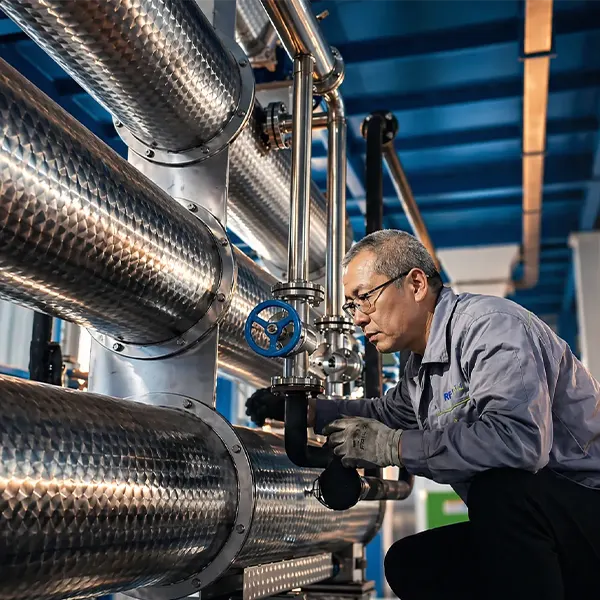
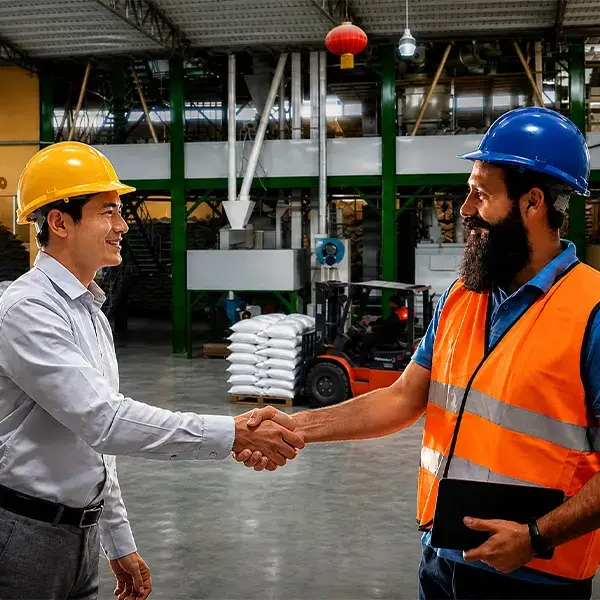
The “turnkey project” we define is far more than the mere delivery of equipment; it is a seamless handover from blueprints to the finished product. As your one-stop supplier, we transform the typically fragmented and high-risk process of plant construction into a unified, standardized service chain.

01
Customized Solutions
From raw material analysis to production capacity planning, our technical team designs the most competitive process solutions by taking into account local energy costs and environmental regulations.
02
Precision Manufacturing
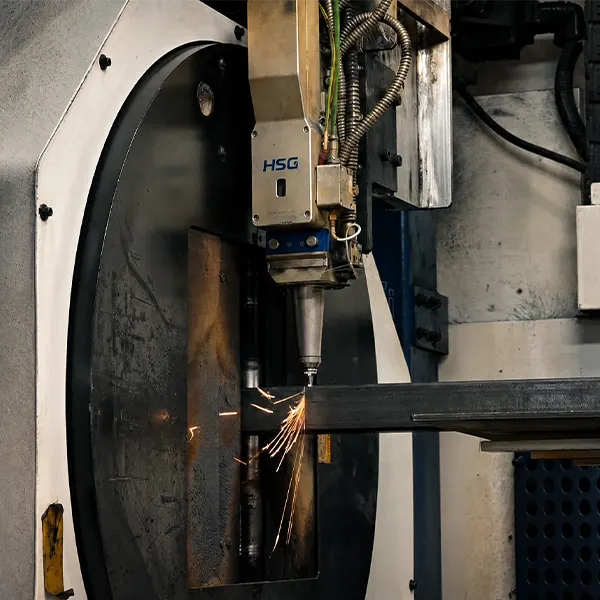
We strictly adhere to the ISO quality management system. All equipment is manufactured using standardized processes and undergoes rigorous quality inspections—including factory trial runs and no-load/load testing—to ensure performance meets required standards.
03
Global Logistics Coordination
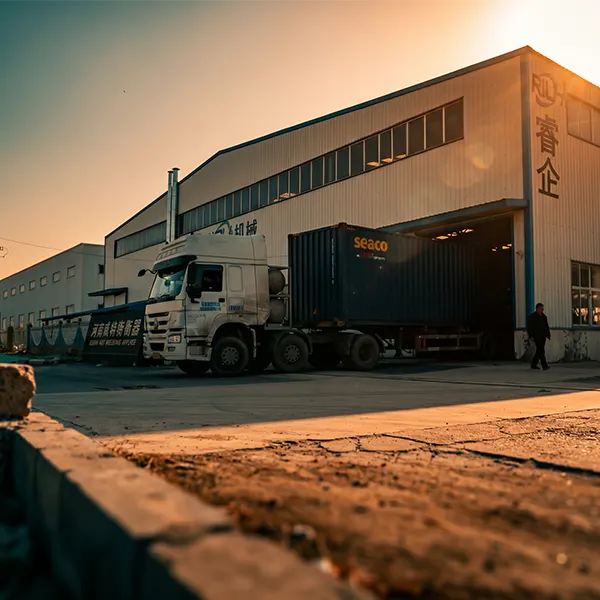
RICHI possesses extensive experience in international logistics operations. We take full responsibility for packing and reinforcement, moisture-proofing, customs documentation, and transport insurance coordination, while tracking the shipment throughout the process to ensure the equipment arrives safely and on schedule at the customer’s factory.
04
Installation and Commissioning
We will dispatch a team of technical experts to the client’s site to handle equipment assembly, piping installation, and electrical connections, as well as to oversee the entire commissioning process until the production line operates stably and meets all performance standards.
05
Operation and Maintenance Training
RICHI engineers provide hands-on, on-site training to staff, covering the complete operating procedure, routine maintenance, replacement of wear parts, and troubleshooting of common issues; English manuals and instructional videos are also provided.
06
Lifetime After-sales Support and Follow-up
The entire unit comes with a 12-month warranty, rapid supply of genuine parts, 24/7 remote technical support, and regular project follow-ups, ensuring long-term, stable production.
About RICHI
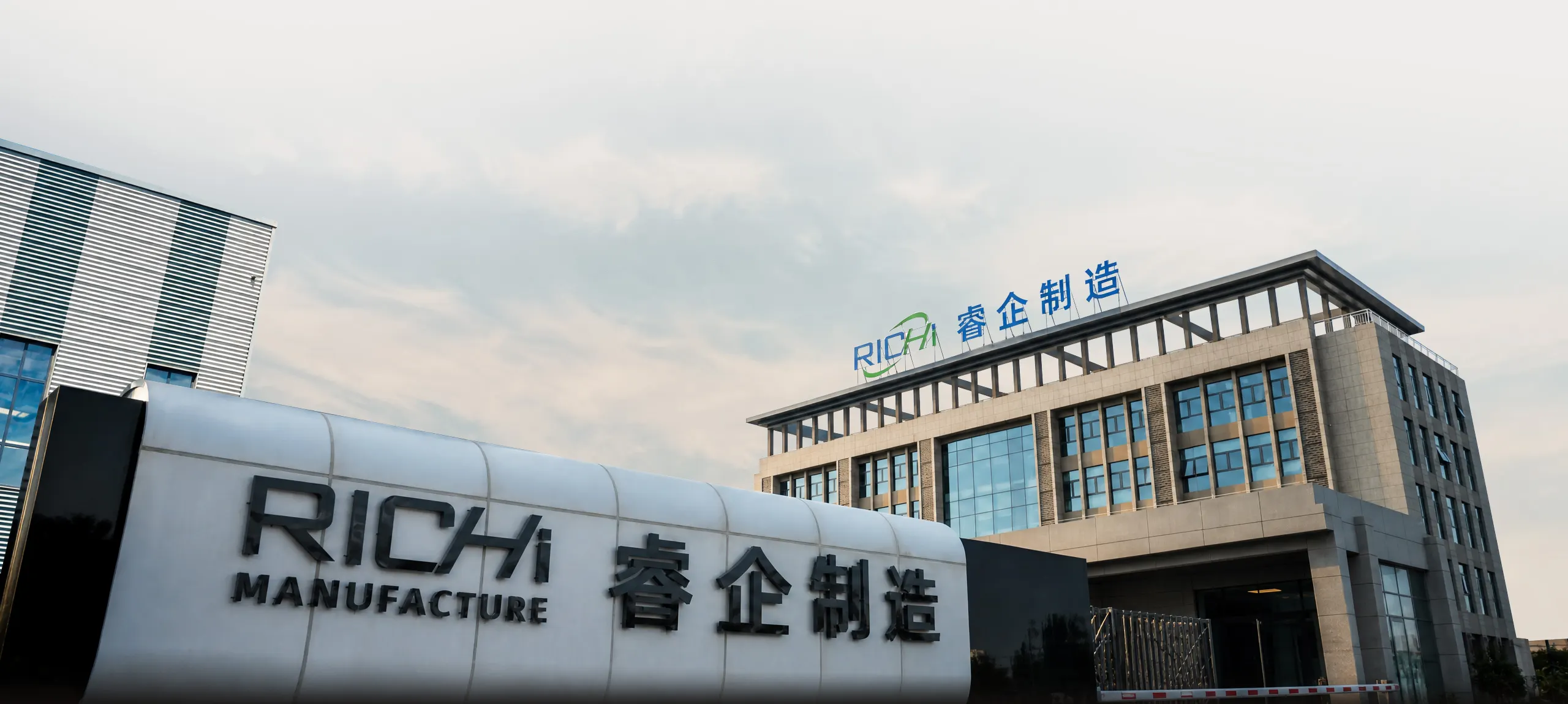
RICHI Manufacture specializes in providing one-stop solutions for sectors including animal feed, pet food, biomass pellets, organic fertilizer, cat litter, and more.
30 Years+
Professional Manufacturer
2000+
Global Project Cases
10000+
Equipment Sold
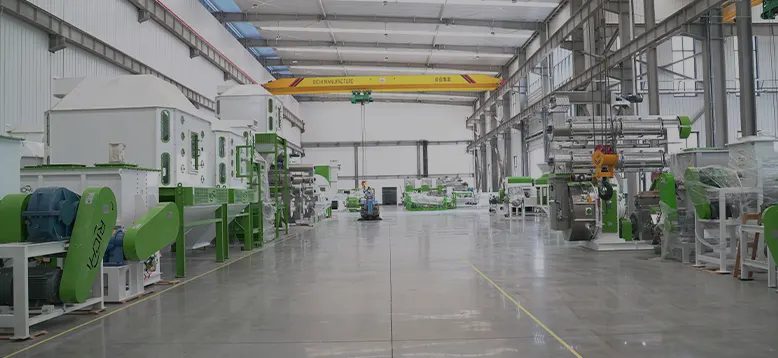
To be art, to be artist. We deliver premium turnkey projects with professional craftsmanship and innovation.
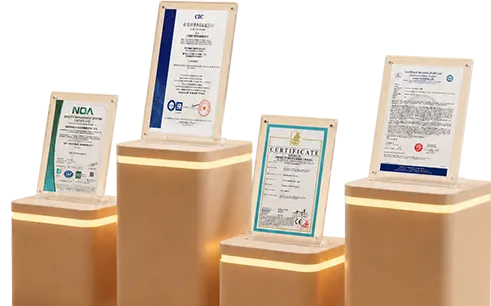
We possess CE, TÜV, Swiss SGS, RTN, BV, ISO9001 certification, and 24 patent certificates.
Client Visit
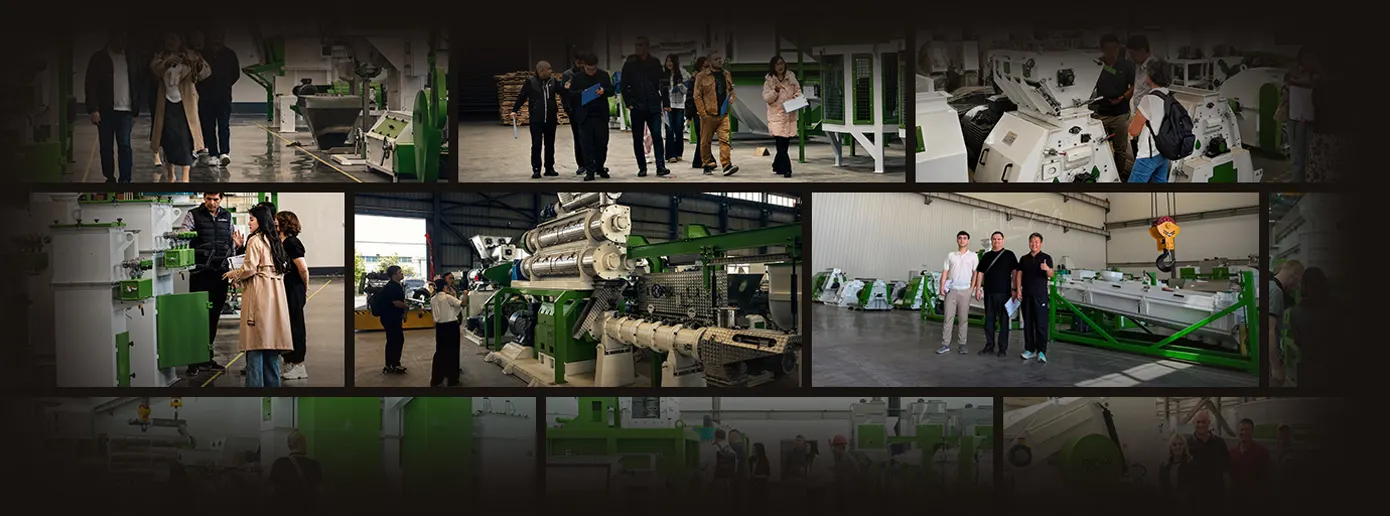
We welcome you to visit our factory for an on-site inspection, where you can witness firsthand our manufacturing capabilities across the entire production process—from raw material processing and component assembly to final machine testing.